Connecticut homeowners feel their heating and cooling bills every season, from January oil deliveries to August air conditioning. It’s natural to assume any exterior upgrade will cut home energy bills by roughly the same amount.
In reality, energy-efficient home upgrades are not created equal. Some deliver noticeable energy savings, while others mainly improve appearance or durability. Starting with the wrong home improvement project can mean waiting years for savings that a different upgrade would have delivered much sooner.
In this guide, we rank the most common exterior upgrades by energy-savings impact so you can prioritize the highest-return investments for your home and budget. We’ll also explain how our team at DiGiorgi evaluates a home’s exterior during a consultation to recommend the upgrade that will make the biggest difference first.
Table of Contents
ToggleWhere Your Home Actually Loses Energy
The Building Envelope Explained
Your home’s exterior, including the roof, walls, windows, and doors, forms the building envelope. It’s the barrier that separates conditioned indoor air from the weather outside.
Energy escapes through that envelope in two main ways:
- Conduction: heat moving directly through materials like glass, framing, and roofing
- Air infiltration: air leaking through gaps, seams, and transitions between components
The upgrades that improve energy efficiency the most address the largest sources of loss in your specific home.
In most homes, both paths are at work at the same time. A drafty window, for example, loses heat through the glass and leaks air around the frame, so the best upgrades tackle both problems together.
Why Connecticut's Climate Raises the Stakes
Long, cold winters make heat loss the dominant energy concern for most Connecticut homes, and humid summers add cooling demand on top of it. Freeze-thaw cycles and seasonal temperature swings also widen gaps around windows, doors, and siding over time, so drafts tend to get worse year after year.
Older Connecticut housing stock adds to the challenge. Many homes still have original single-pane windows, minimal wall insulation, and aging roofs, which leaves plenty of room for improvement.
You may already be seeing the signs of energy loss in your own home:
- Drafts near windows and exterior doors on windy days
- Upstairs rooms that stay hot in summer and cold in winter
- Ice dams forming along the roof edge after snowstorms
- Condensation or frost on the inside of window glass
- Heating bills that keep climbing even when your thermostat habits stay the same
The Energy Efficiency Hierarchy: Exterior Upgrades Ranked by Savings
The ranking below reflects the typical energy impact of each energy efficiency upgrade in an older Connecticut home, from the largest potential savings to the smallest.
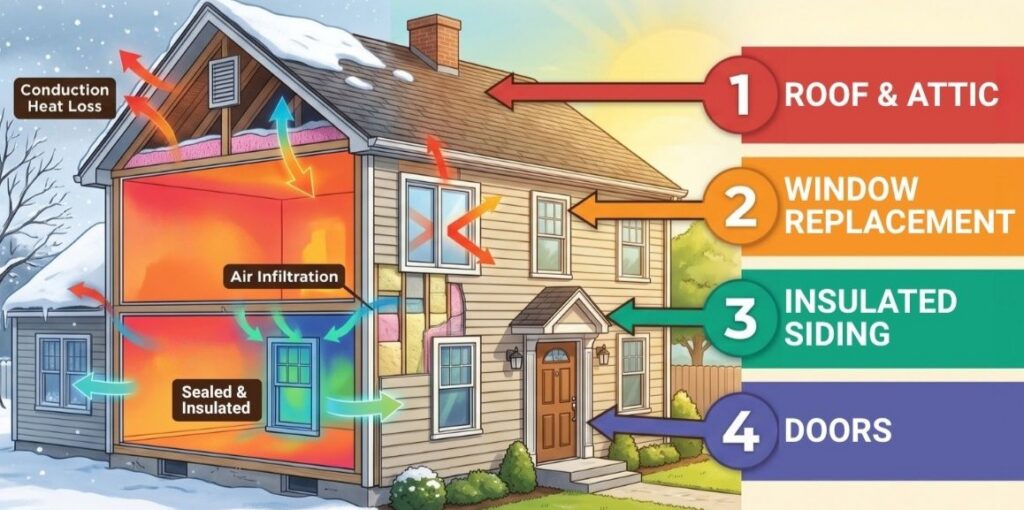
1. Roof Replacement with Attic Ventilation and Insulation Improvements
Heat rises, so an under-insulated, leaky attic is a major source of winter heat loss in Connecticut homes, through both conduction and air infiltration.
A roof replacement is the ideal time to fix these problems. With the roof deck exposed, it’s much easier to correct attic ventilation and address air leaks and insulation gaps that are hard to reach later.
Balanced ventilation helps prevent ice dams in winter and reduces attic heat buildup in summer, easing the load on your HVAC system. Cool roofing materials and lighter-colored asphalt shingles can also reduce summer heat gain, though that effect is smaller in heating-dominated climates like ours.
If your upstairs rooms are uncomfortable or you see icicles and ice dams every winter, your attic may be the real culprit. Pairing a new roof with attic improvements turns a necessary repair into an energy upgrade.
2. Window Replacement: A Major Opportunity in Older Homes with Single-Pane Windows
Windows are one of the largest sources of heat loss and gain in a typical home, especially single-pane or failing double-pane units. Windows account for a significant amount of the heat that passes through the building envelope, which directly affects your home’s energy use.
Modern ENERGY STAR-rated windows combat that loss with low-E glass coatings, gas-filled panes, and insulated frames that reduce conduction through both the glass and the frame.
If your windows feel cold to the touch in winter, rattle in the wind, or fog up between the panes, they are likely driving up your energy costs every month.
Proper installation matters as much as the product. Flashing, air sealing, and insulating the rough opening stops air from leaking around a brand-new window. That’s why our window and door replacement process focuses on the opening as much as the unit itself.
3. Insulated Siding and a Proper Weather-Resistant Barrier
Wall studs act as thermal bridges, letting heat bypass the insulation in your wall cavities. Insulated siding adds a continuous layer of thermal insulation over the studs that reduces this conduction loss.
A siding project is also a good time to install new house wrap, which reduces air infiltration through the walls. Many older homes have no weather-resistant barrier at all.
Because a siding upgrade also adds durability and curb appeal, it provides lasting protection alongside energy benefits.
For homes with older, uninsulated walls, this combination of continuous insulation and a tight barrier can make rooms noticeably more comfortable, especially along exterior walls that once felt cold.
4. Entry and Patio Door Replacement
Doors cover less surface area than windows or walls, so their overall conduction loss is usually smaller. Still, worn weatherstripping, warped slabs, and older sliding patio doors can cause noticeable drafts and cold spots. Insulated fiberglass or steel entry doors and energy-efficient patio doors are a strong final step once larger sources of loss are addressed.
Why the Right Order Depends on Your Home
When the Hierarchy Shifts
A general ranking is a helpful starting point, but every home is different, and an energy audit, which typically includes a blower door test to measure air leaks, can reveal where yours is losing the most. The order can change when:
- Your roof is newer and your attic is already well insulated and ventilated, but you still have original single-pane windows, making window replacement the bigger opportunity
- Your walls have insufficient insulation or none at all, so insulated siding may deliver more savings than the ranking suggests
- You see visible damage such as rotting trim, failing flashing, or roof leaks, since moisture problems also undermine energy performance
This is why we look at the home exterior as a system, not a collection of separate projects.
Budget and Phasing Considerations
You don’t have to tackle all your energy-efficient home improvements at once. A clear priority list lets you phase projects over several years while still getting the biggest savings first.
Pairing related work can also make sense. Replacing windows and siding together, for example, can reduce labor costs and ensure the transitions between components are properly sealed.
A typical phased plan might start with the roof and attic in year one, move to energy-efficient windows next, and finish with siding and doors as the budget allows. The key is having a plan, so each project builds on the last.
Incentives may help, too. Energize Connecticut offers rebates and programs that may apply to qualifying energy-efficient improvements such as insulation, so confirm current eligibility before you start. Note that the federal 25C tax credit for windows, doors, and insulation applied only to upgrades placed in service by the end of 2025, so it is no longer available for new projects.
Get Expert Guidance on Your Highest-Impact Upgrade from DiGiorgi
For most older Connecticut homes, the energy efficiency hierarchy runs in this order:
- Roof replacement with attic ventilation and insulation improvements
- Window replacement
- Insulated siding with a proper weather-resistant barrier
- Entry and patio door replacement
That order should always be adjusted to your home’s specific conditions. Generic rankings are a starting point; the biggest savings come from knowing exactly where your home is losing energy.
During a consultation, our team closely examines the condition and age of your windows, your roof and attic ventilation, your siding and what lies beneath it, and the seals around your doors. Even when you call us about one project, our consultation looks at how it connects to the rest of your exterior. That way, you’ll understand which upgrade will deliver the most value first.
Family-owned since 1933, DiGiorgi provides expert roofing, siding, window, and door services that help Connecticut homeowners invest in energy-efficient home upgrades with confidence.
Contact DiGiorgi or call (203) 723-6880 for a free consultation, and find out which exterior upgrade will save your home the most energy, shrink your carbon footprint, and fit your budget.